1.The oculus kinetic unit
1-1) Function of curved surfaces


The oculus kinetic unit consists of a circular frame and two curved surfaces. The primary function of the upper curved surface is to block solar radiation during the summer season when the solar altitude is high.
The bottom surface reflects incoming daylight for better daylight distribution during the winter season when the sun's altitude is low.
1-2) Kinetic motion of the oculus unit

The oculus kinetic unit can be rotated in a clockwise and counterclockwise direction to respond to the hourly sun's position. The inflow of daylight can be controlled through rotational motion. This motion makes it possible to consider the external weather condition and user preference to create a better indoor environment.
2.The optimization of the curved surface of oculus unit
2-1)Design parameters

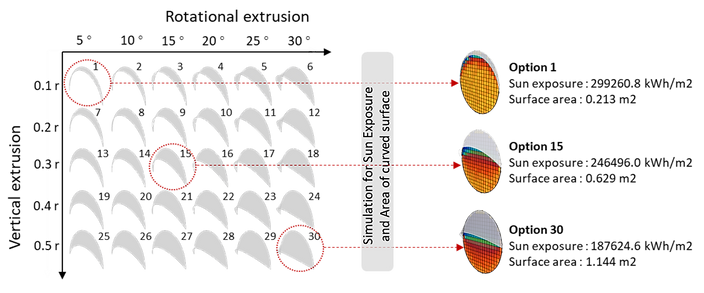
2-2)Generated design options and Simulations
2-3)Min-Max normalization

Since there are two objectives, sun exposure and surface area, to consider, this research used the min-max normalization method to convert all the original values of different objectives into the normalized value between 0 and 1. The min-max normalization method is a normalization strategy to transform the original data into the normalized condition. This method is useful for integrating the results of multiple simulations using different units. The original values are converted by the following equation:
2-4)Integrated results and Selected optimal forms of oculus curved surface

3. Facade module


Option 15
Rotation gears
&Circular frame
Holding rod
Insulated
Glass Unit
System
The images show the oculus kinetic facade module and its exploded condition. The oculus kinetic facade module is placed between the insulated glass unit (IGU) to be protected from harsh weather conditions. The rotational movement of the entire oculus units can be controlled by a rotating gear installed in the center frame of the facade module.
4. Fabrication


Incoming daylight
Blocking daylight
Similar Front view
But,
Different performance
5. Integration with Flexible photo-voltaic film (NSF i-Corp)
This project incorporates an adaptable organic photovoltaic (OPV) systems that allows maximum solar power production while being able to respond to varying internal and external environmental influences from the sun and users. A series of adaptable OPV systems are encapsulated between two panes of glass to guarantee long-term operation and easy maintenance. The OPV system consists of micro-OPV shades attached to a circular gear frame, and is rotating according to sun positions. The aim of this research is to develop a facade module which is able to balance multidimensional functionalities between solar heat gain, daylighting transmission, user privacy, glare protection, and unobstructed views to the outside. The Maximum Power Point Tracking (MPPT) algorithm is used to maximize solar power production and reduce the solar heat gain at the same time. An individual micro-juction box at the micro-OPV module incorporates a bypass diode to maintain stable energy production efficiency when partial shading occurs.
6.Building Facade Application

Facade unit frame
Sub-gear (Rotation)
Oculus kinetic unit
10 AM
12 PM
3 PM
7. Building Application (Micro)


Oculus 180 deg
Oculus 60 deg
Oculus 0 deg

8. Performance simulations

8-1) Daylight simulation at 12:00 PM on June 21st

8-2) Data collection process of hourly daylight simulation results
8-3 Solar irradiance simulation at 12:00 PM on June 21st

8-4) Data collection of hourly solar irradiance simulation result
9. Achievement
9-1) Research funding: National Science Foundation
(Stage 1: $3,000 / Stage 2: $50,000 / Total :$53,000)
9-2) Published paper: SimAUD 2019 (p.303-309)
(Title: A unified framework for optimizing the performance of a kinetic facade)
http://www.simaud.org/proceedings/download.php?f=SimAUD2019_Proceedings_LowRes.pdf
